


What is the difference between coil reinforced tubing and braided reinforced tubing?
Q1: What is the structural difference between coil reinforced tubing and braided reinforced tubing?
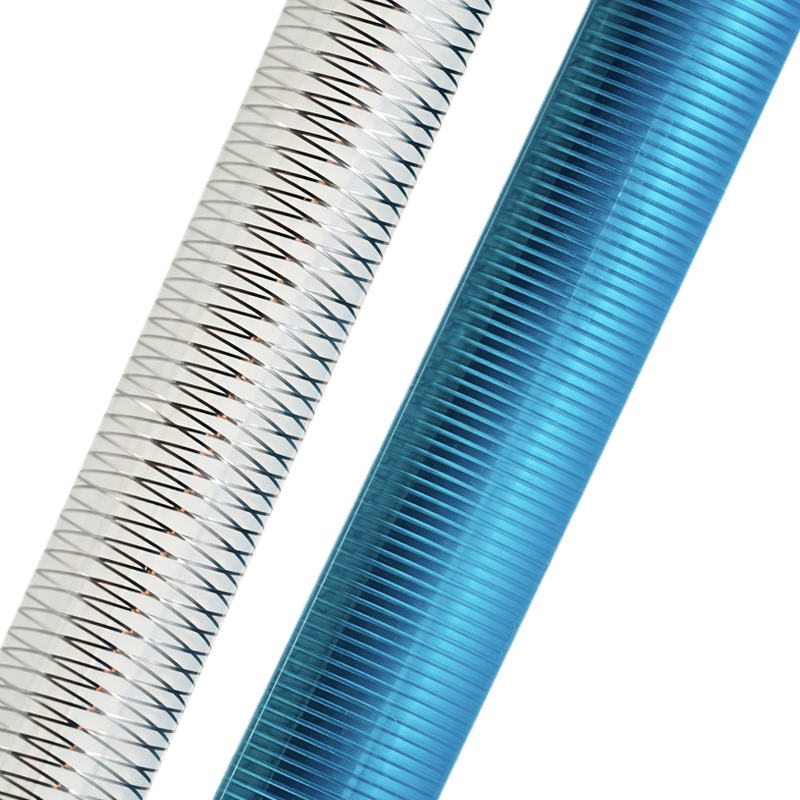
A1: Medical grade coil reinforced tubing BH-MT-CRT uses one or more wires or filaments wound helically around the tubing axis. The coil may be monofilament or multi-filament and use flat or round wire profiles. Medical grade braided reinforced tubing BH-MT-BRT uses multiple strands interlaced in a crisscross pattern. In the BH-MT-BRT construction, the braid is encapsulated between an inner liner and an outer jacket, forming a three-layer structure. In simple terms, coil reinforcement provides spiral support, while braided reinforcement provides interwoven mesh support.
Q2: Which tubing is more flexible?
A2: For comparable OD, wall thickness, wire size, and polymer hardness, coil reinforced tubing is generally more flexible and easier to bend. The coil allows the tubing to follow tight curves while supporting the wall. Braided tubing can also be flexible when designed with a softer jacket or lower braid density, but its intersecting strands generally create greater bending stiffness.
Q3: Which tubing provides better torque transfer?
A3: Braided reinforced tubing generally provides more efficient torque transfer because its interlocked strands resist rotational deformation and reduce wind-up. Coil reinforced tubing can also provide torque capability, particularly with close-wound or well-bonded designs, but it may show more rotational lag when the catheter is simultaneously bent, pushed, and rotated.
Q4: Which tubing has better kink resistance?
A4: Both constructions improve kink resistance. Coil reinforcement usually performs better in tight-radius bending and repeated flexing because the spiral provides local circumferential support. Braided reinforcement provides good kink resistance together with higher axial and torsional stability, but it may be less conformable when the required bend radius becomes very small. Actual minimum bend radius should be validated for each design.
Q5: Which tubing withstands higher burst pressure?
A5: Braided reinforced tubing is generally preferred for higher-pressure applications because the interwoven braid distributes hoop and axial loads more effectively. Coil reinforcement can also improve burst strength and pressure endurance, but performance depends on wraps per inch, wire material and cross-section, bonding, wall thickness, polymer properties, and termination design. Burst pressure must be verified by testing the finished tubing configuration.
Q6: Which tubing provides better pushability?
A6: Braided reinforced tubing generally provides better pushability because it offers higher axial compressive stiffness, compression resistance, and resistance to elongation. Coil reinforced tubing may buckle under higher axial loads, especially when optimized primarily for softness. Pushability can be improved through wire size, coil pitch, jacket hardness, or wall thickness, although these changes may reduce flexibility.
Q7: How do materials affect the comparison?
A7: Material selection can be as important as reinforcement geometry. BH-MT-CRT coil reinforced tubing can use stainless steel, nitinol, tungsten, and other metal or polymer monofilament and multi-filament materials. Jacket options include Nylon, Pebax, urethane, polyimide, particle-filled polyimide composites, polyamide-imide, polyester, and PPSU. BH-MT-BRT braided reinforced tubing can use nitinol, stainless steel, fabric, Kevlar, platinum, and other braid materials. Liner and jacket options include PTFE, Nylon, FEP, ETFE, HDPE, Pebax, and other thermoplastics or fluoropolymers.
Q8: What are the main advantages of coil reinforced tubing?
A8: Coil reinforced tubing offers high softness and bendability, good maneuverability in tortuous anatomy, resistance to localized kinking and collapse, suitability for repeated flexing, and easier routing and positioning of flexible instruments. Coil pitch, wire profile, and jacket material can be customized. Tapered coils and hole punching are also available for specific designs.
Q9: What are the limitations of coil reinforced tubing?
A9: Coil reinforced tubing may provide lower axial pushability and torque efficiency than an optimized braided shaft. It may also show axial elongation or buckling under high push force. Its burst-pressure performance may be lower than that of a comparable braided design. These characteristics depend strongly on coil geometry, bonding, wall thickness, and jacket selection.
Q10: What are the main advantages of braided reinforced tubing?
A10: Braided reinforced tubing offers strong torque transmission, improved pushability, high burst-pressure capability, crush and compression resistance, resistance to collapse under vacuum, limited axial stretch, and good dimensional stability. It is suitable for high-performance catheter shafts, pressure lines, and applications requiring controlled push and rotation.
Q11: What are the limitations of braided reinforced tubing?
A11: Braided reinforced tubing may have greater bending stiffness and less conformability than a comparable coil design. Braid pattern, density, wire size, and jacket hardness must be carefully balanced to avoid excessive stiffness. The construction may also involve greater manufacturing complexity and cost, particularly for custom or hybrid designs.
Q12: Which applications are better suited to coil reinforced tubing?
A12: Coil reinforced tubing is generally suitable for deflectable catheters, endoscopes, graspers, flexible instruments, deployment mechanisms, distal catheter sections, and intravascular devices that must navigate sharp turns without collapsing. It is particularly useful where flexibility, maneuverability, and repeated bending are primary requirements.
Q13: Which applications are better suited to braided reinforced tubing?
A13: Braided reinforced tubing is generally suitable for cardiovascular and heart-valve delivery systems, neurovascular catheters, electrophysiology catheters, ablation catheters, biopsy devices, endoscopic devices, high-pressure fluid transfer lines, anti-kink tubing, and deflectable-tip catheter systems requiring proximal shaft control.
Q14: Can coil and braided reinforcement be combined in one catheter?
A14: Yes. A hybrid design can use a braided proximal section for pushability, torque, and shaft support, combined with a coil reinforced distal section for flexibility, bendability, and kink resistance. Variable jacket hardness or tapered reinforcement can also be used. Transition zones should be carefully designed and validated to avoid stiffness steps, weak bonding, or localized kinking.
Q15: What information should be included in an RFQ or technical specification?
A15: A practical RFQ should include the intended application, ID, OD, wall thickness, length, tolerances, target minimum bend radius, working and burst-pressure requirements, push-force requirements, torque-response requirements, vacuum resistance, reinforcement type, reinforcement material and wire size, coil WPI or braid pattern, liner and jacket materials, lubricity requirements, sterilization method, biocompatibility documentation, prototype quantity, expected annual volume, and acceptance criteria.
Q16: What performance tests should be considered before final selection?
A16: Depending on the device risk profile and intended use, relevant tests may include minimum bend radius, kink resistance, push force, buckling, torque response, torque-to-failure, burst pressure, leakage, vacuum collapse, tensile strength, elongation, flex fatigue, dimensional inspection, reinforcement-to-jacket bond integrity, surface friction, sterilization compatibility, and accelerated aging.
Q17: Does “medical grade” mean the finished device is already approved?
A17: No. “Medical grade” should be supported by material documentation, manufacturing controls, and agreed specifications. The product datasheets state compliance with ISO 10993-1 and USP Class VI, but this does not replace biocompatibility evaluation, sterilization validation, risk analysis, or regulatory review of the finished medical device.
Q18: How should I choose between coil and braided reinforced tubing?
A18: Choose coil reinforced tubing when softness, tight-radius bending, and distal maneuverability are the main priorities. Choose braided reinforced tubing when torque transfer, pushability, burst pressure, crush resistance, and shaft stability are more important. Consider a hybrid braid-and-coil construction when the device requires both proximal control and distal flexibility.

Datasheet:
BH-MT-CRT-EN.pdf
BH-MT-BRT-EN.pdf