


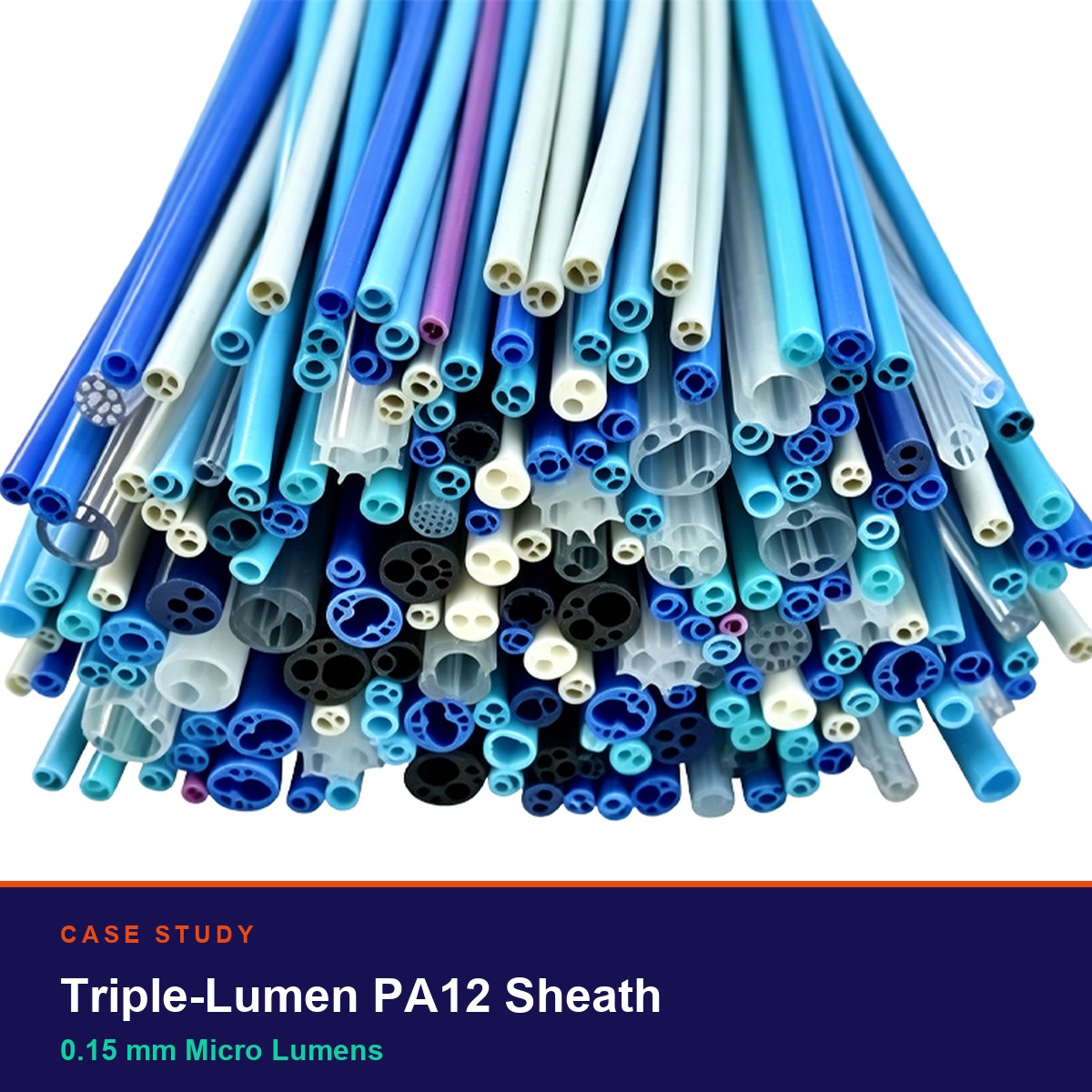
Triple-Lumen PA12 Sheath with 0.15 mm Micro Lumens
0.15mm
Micro-lumen inner diameter, ±0.05 mm
279mm
Overall length, ±3 mm
30°
Lumen angular position, ±5°
100%
Lot inspection compliance
Summary
The part that had almost no wall left
A global medical device manufacturer needed a precision triple-lumen sheath for its endoscopic Scope Wiper and Irrigation Cleaning System. The drawing specifies one large irrigation lumen of 5.44 mm minimum bore and two micro channels in the same wall: an oval channel 0.46 × 0.15 mm and a circular one of Ø0.15 ± 0.05 mm, 30° ± 5° apart.
Controlling the rotational, or twist, accuracy of those two micro lumens along a 279 mm tube was the decisive engineering challenge. After several rounds of tooling modification and continuous process optimization on our precision extrusion lines, the production output fully met the customer’s expectations, and drew direct praise from their engineering team for the quality of the ultra-thin walls.
| Part profile | Detail |
|---|---|
| Application | Endoscopic Scope Wiper and Irrigation Cleaning System |
| Product | Triple-lumen extruded sheath, drawing L-DRW-163 Rev. F |
| Material | VESTAMID CARE ML21, medical-grade Nylon 12 (PA12) |
| Configuration | One large lumen plus two micro lumens at 30° ± 5° |
| Nominal size | 5.44 mm bore, 279 mm length, clear |
| Reference lot | PA20260627001, 100 pcs, COC No. 20260701039 |
Customer identity withheld. The drawing requires the main channel to be the same size or larger than the other channels, with an oval cross-section preferred and a circular lumen acceptable.
01 — The Challenge
Three reasons this cross-section was harder than its dimensions
Micro lumens at the edge of measurability
The two small channels specify an inner diameter of only 0.15 ± 0.05 mm, roughly the thickness of a human hair. Achieving that orifice in the die and then holding it stable through sizing and cooling, leaves almost no tolerance for melt instability, die wear, or pressure fluctuation. Any of these shows up immediately as a blocked, ovalized, or drifting channel.
An ultra-thin outer wall
The drawing specifies only the bore (5.44 mm minimum) and the outside diameter (5.77 mm maximum); it carries no wall callout, so the wall thickness at the channel location cannot be derived from the drawing. What the drawing does fix is the geometry inside that wall: an oval channel 0.46 mm wide and 0.15 mm high and a circular channel of Ø0.15 ± 0.05 mm, their centres 0.46 mm apart at a 30° ± 5° angular position. The tooling has to open both channels in that wall, keep them from collapsing during sizing and cooling, and meet the drawing’s condition: oval preferred, never smaller than the other channel.
Rotational accuracy of the micro lumens
Because the cross-section is asymmetric and the channels are microscopic, the two micro lumens tend to rotate around the tube axis as the material is drawn down, cooled, and handled downstream. Keeping their 30° relationship stable from one end of the 279 mm tube to the other was the hardest parameter to control in production.
02 — Engineering Approach
Iterative tooling, not a single machine setup
- Multiple tooling iterations. The die and tip geometry was reworked several times to balance melt flow between the thick and thin wall regions, stabilize the micro-channel openings, and hold the 30° angular orientation of the two small lumens.
- Continuous process optimization. Melt temperature, screw speed, draw-down ratio, vacuum sizing, and cooling profiles were tuned step by step across several trial runs until the cross-section geometry locked in and stayed stable.
- Precision extrusion platform. The final process ran on precision extrusion lines with tight closed-loop control of temperature and output, delivering the repeatability that 0.15 mm channels demand.
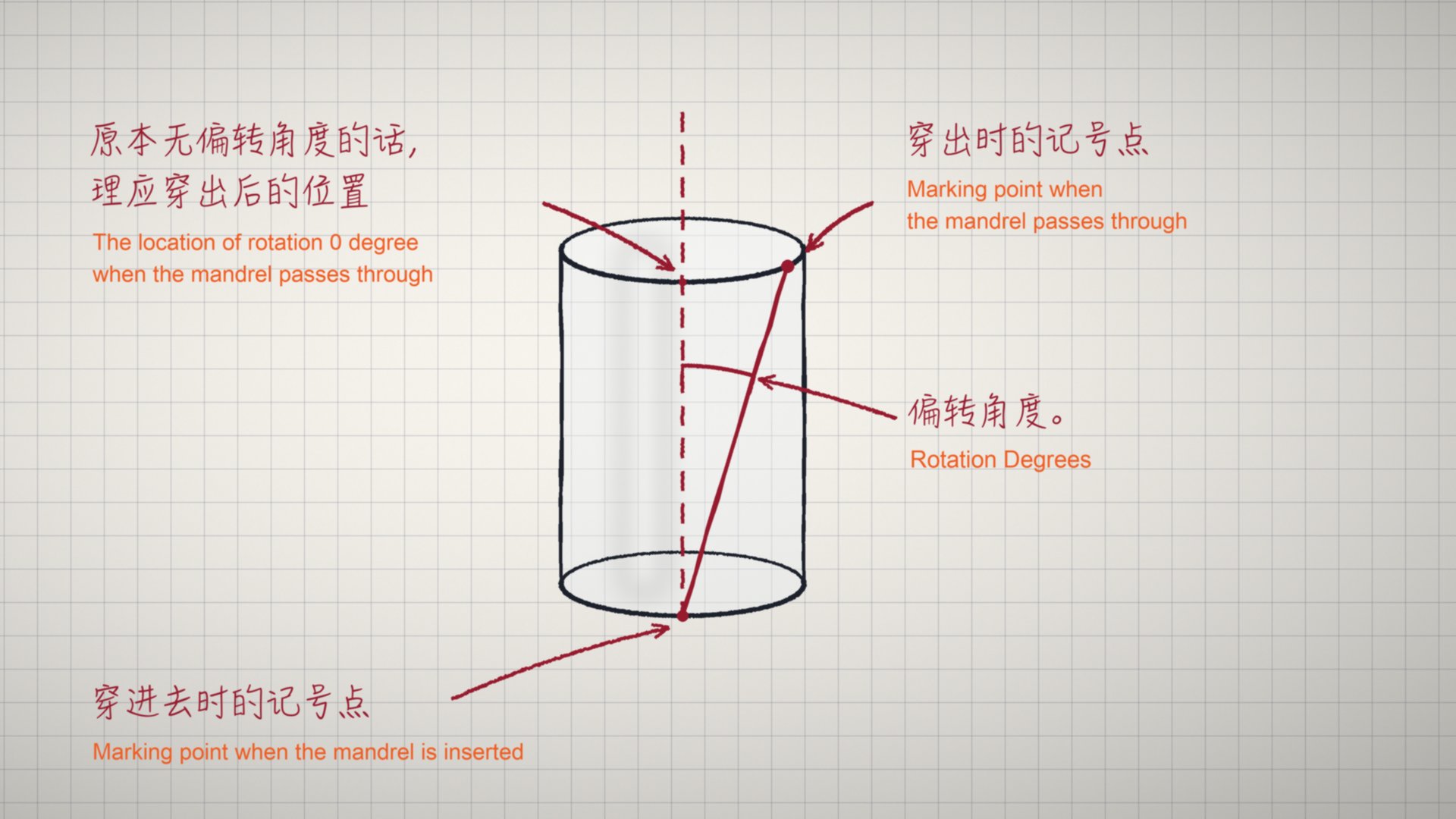
- Objective twist verification. Lumen twist is quantified with a mandrel pass-through method: a reference mark is made where the mandrel enters at one end, and a second mark where it exits at the other. The angular offset, the rotation degrees, measures exactly how far the lumen has twisted along its length.
“The L-163 extrusions are excellent. We are very impressed with the quality and especially impressed with how well the ultra-thin walls came out — please give your team strong compliments on our behalf!”
Customer engineering team, after receiving the production lot
The feedback matches the inspection data: the difficulty of this part was never the nominal bore or the outer diameter, it was forming two micro channels inside the same wall. An oval 0.46 × 0.15 mm channel and a Ø0.15 mm circular channel can only be produced with stable melt flow, correctly balanced tooling, and disciplined process control.
03 — Verified Results
Every characteristic in compliance
Production lot PA20260627001 (100 pcs, manufactured 2026-06-27) was fully inspected against the drawing specification.
| Analytical item | Specification | Actual values (1–5) | Judgement |
|---|---|---|---|
| Extrusion OD | ≤ 5.77 mm | 5.676 / 5.682 / 5.711 / 5.763 / 5.750 mm | Complies |
| Big lumen ID | ≥ 5.44 mm | 5.44 / 5.44 / 5.44 / 5.44 / 5.44 mm | Complies |
| Small lumen ID 1 | 0.15 ± 0.05 mm | 0.10 / 0.11 / 0.12 / 0.11 / 0.12 mm | Complies |
| Small lumen ID 2 | 0.15 ± 0.05 mm | 0.12 / 0.12 / 0.11 / 0.11 / 0.12 mm | Complies |
| Angle | 30° ± 5° | 34.3 / 31.7 / 30.3 / 30.9 / 34.5 | Complies |
| Length | 279 ± 3 mm | 281 / 282 / 281 / 282 / 282 mm | Complies |
| Appearance | No stretch marks, wrinkles, oil stains, impurities, spots, pinholes, bubbles or deformation; uniform, smooth outer surface | Conforming | Complies |
Source: Certificate of Conformity FLY/QR023-03-A, No. 20260701039, dated 2026-07-01.
✓Certificate conclusion: Shipment Allowed
04 — Why It Matters
What this part proves about our capability
Capability at micro scale
Holding actual channels of 0.10–0.12 mm against a 0.15 ± 0.05 mm specification, and keeping the oval channel at 0.46 × 0.15 mm, is extrusion capability very few suppliers can offer for medical micro-tubing.
Twist control as a differentiator
Lumen orientation is not cosmetic: if the micro channels rotate out of position, downstream device assembly fails. Our rotation measurement turns a hidden risk into a controlled, verifiable parameter.
A repeatable process
The results come from a fully inspected production lot after multiple tooling and process iterations, evidence of a stable, transferable manufacturing process rather than a lucky sample.
Medical-grade material assurance
Processing VESTAMID CARE ML21 (medical-grade PA12) preserves the biocompatibility and performance pedigree that endoscopic cleaning applications require.
05 — Reference Documents
Source documents
The customer drawing and the certificate of conformity issued for the inspected lot are available for download.